Our first actual day in the Daintree was a blur of ID workshops and keying out, but the best part was going to the Marrdja Boardwalk to check out some endemic species. The boardwalk is located at the meeting of two creeks, one originating in a rich mafic valley, and the other from a nutrient poor granitic origin, so there is a nice spattering of some really cool things.
First up is an
Entada, or matchbox bean. I'm not sure of the species because you need to get a good look at the leaflet structure, and this one didn't want to play the game. You can tell that it is
Entada though, because of the keeled vine which isn't very obvious due to my shitty photography skills.
We move further along the boardwalk to what I think is Oliver Creek.
And just along from there we have some
Lepidozamia hopei, a Queensland endemic cycad, and is the biggest cycad species in the world.
And also some
Bowenia spectabilis, another Queensland endemic cycad.
This was the first wild one I had seen, but when I stopped at Tully on the way home, they were everywhere. I had not seen them there in previous years, so it may have just been a case of timing.
Poking around in the understorey reveals one of my favourites:
Selaginella longipinna. Shitty pic.
Though fern-like in appearance, these are actually a type of spikemoss. They look really really cool in large drifts, and the reproductive structures are cool and show the resemblance to tassel ferns. But this one has no strobili so we will get to that later.
Just up the path is a really cool strangler fig,
Ficus destruens. You can see how they begin as an epiphyte, then create a lattice of roots to strangle the host tree. The host of this individual has long since died and rotted away, leaving a cool tunnel, and a lopsided strangler fig.
Another really cool FNQ endemic at the boardwalk is
Idiospermum australiense, called idiot fruit or ribbonwood. A rather nondescript looking tree, the flowers are pretty cool and smell sort of like bubblegum. The 'fruit' are technically naked embryos, because the flesh and any 'fruit' structures rot away on the tree. These embryos are quite large, and split into quarters when they sprout.
The story behind this species is quite cool. It was thought to have gone extinct when major sugar cane operations cleared rainforest, but many years later, a farmers cattle were all dying mysterious deaths. Suspicious that someone may be trying to take his land, autopsies of the dead cattle were conducted to find the cause of death. All that was found were these huge giant seeds that no one seemed to recognise. These seeds were sent off to a herbarium or museum or something and identified as
Idiospermum, confirming that the species never went extinct. Now they seem to grow like weeds.
Another curious thing about
Idiospermum is that it seems to have no effective seed dispersal method. The embryos are so toxic that anything that tries to eat them dies, so can not be spread through the dung of herbivores. Musky rat kangaroos sometimes take the embryos and bury them, but never eat them. Currently, pretty much the only way that
Idiospermum spreads is by gravity, when the fruit roll down hills. It is thought that because it is so toxic to modern day creatures, that it was perhaps dispersed by now extinct megafauna, once upon a time.
 |
| Idiospermum flower |
This little thing is
Phricta spinosa, the prickly forest katydid. And yes, I did actually get close to it.
Walking further along the boardwalk reveals some of my other favourites - tassel ferns (
Phlegmariurus). These ancient wonders are not true ferns, but a type of lycopod, like Selaginella. They are commonly grown in cultivation, with a reputation for being delicate and finicky. Yet, here they are in the wild, high in the canopy where they belong. So cool.
From here the vegetation starts to open up a little as it transitions to a mangrove rainforest. There is less of a shrub layer, and pools of water and ferns dominate the ground layer. There are large emergents festooned in epiphytes, with a notable one being an undescribed species of
Freycinetia.
Freycinetia are in the same family as
Pandanus and are often called climbing pandans. They are root climbers, and a quick look at the roots, toothed leaves and the fruit reveals why they are in
Pandanaceae. The specimens along the boardwalk were not fruiting though.
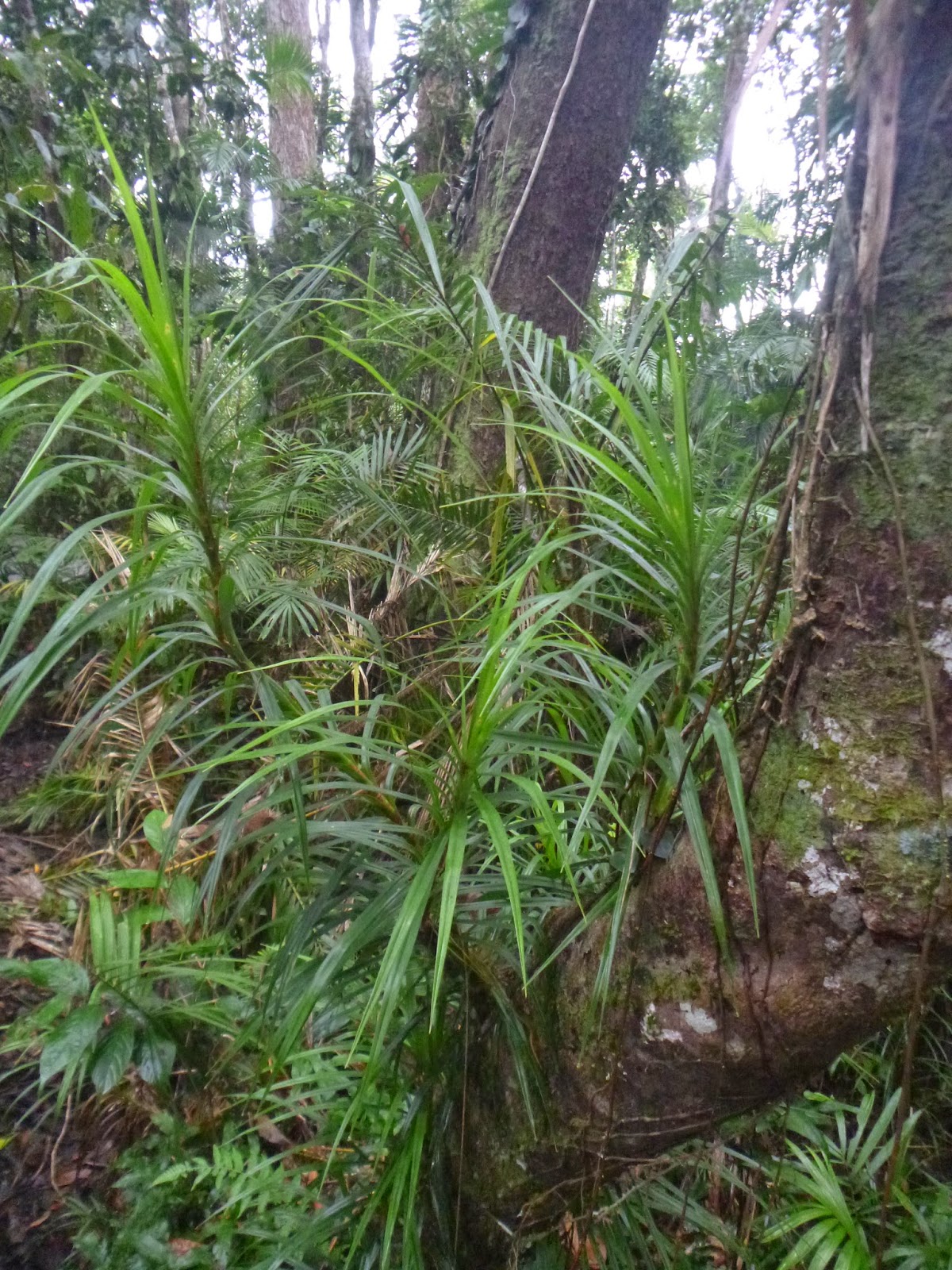 |
| Undescribed Freycinetia. Cool stuff |
Like I said, festooned with epiphytes. This single tree had a
Piperaceae vine (right) a
Schefflera (top left), some type of fern (
Pyrrosia perhaps, bottom left), and a ginger (bottom right, which I have never seen growing as an epiphyte before).
The vegetation changes quite suddenly to the mangrove rainforest, which is really cool. Due to the saline conditions, only a select few plants can grow here. The trees are not as large as the rainforest emergents, but are considerably larger than others I have seen in the mangrove forest elsewhere in Queensland. The ground layer is very sparse, with mangrove ferns (
Acrostichum speciosum) dotted here and there. A specialised marine moss also grows in patches on the mud. Epiphytes such as basket ferns (
Drynaria),
Dischidia, and orchids grow plentifully here, which makes me wonder about the degree of orchid thieving that occurs here.
 |
| A basket fern (Drynaria) with ribbon fern (Vittaria) growing from the basket |
 |
| Cymbidium madidum |
|
|
 |
| Pandanus solms-bauchii |
 |
| Bulbophyllum baileyi |
 |
| Dischidia major |
Dischidia major (above) is in the same genus as the button 'orchid'
Dischidia nummularis that we saw at Machens Beach (and was also growing here). but these two species have distinctly different leaf morphologies. This is because
major is a
myrmecophyte, meaning that it lives in a mutualistic association with ants. The leaves are swollen due to tunnels which house the ants. Cool stuff.
 |
| A whisk fern (Psilotum), featuring Dr Field's pointing staff |
 |
| A shit photo of a shit specimen of Dischidia nummularis |
 |
| Dendrobium baileyi |
 |
| A dead Dendrobium nindii :c |
Dendrobium nindii (above) has been on my botanical bucket list for quite some time now. It is a really cool, special
Den, with showy soft purple flowers with twisted petals which has earned it the name of antelope orchid. It is listed as an endangered species, due to poaching and habitat degradation.
 |
| A Cymbidium madidum growing on a root of a Xylocarpum granatum (I think). It was really close to the mud. Crazy Stuff |
 |
| More Bulbophyllum baileyi |
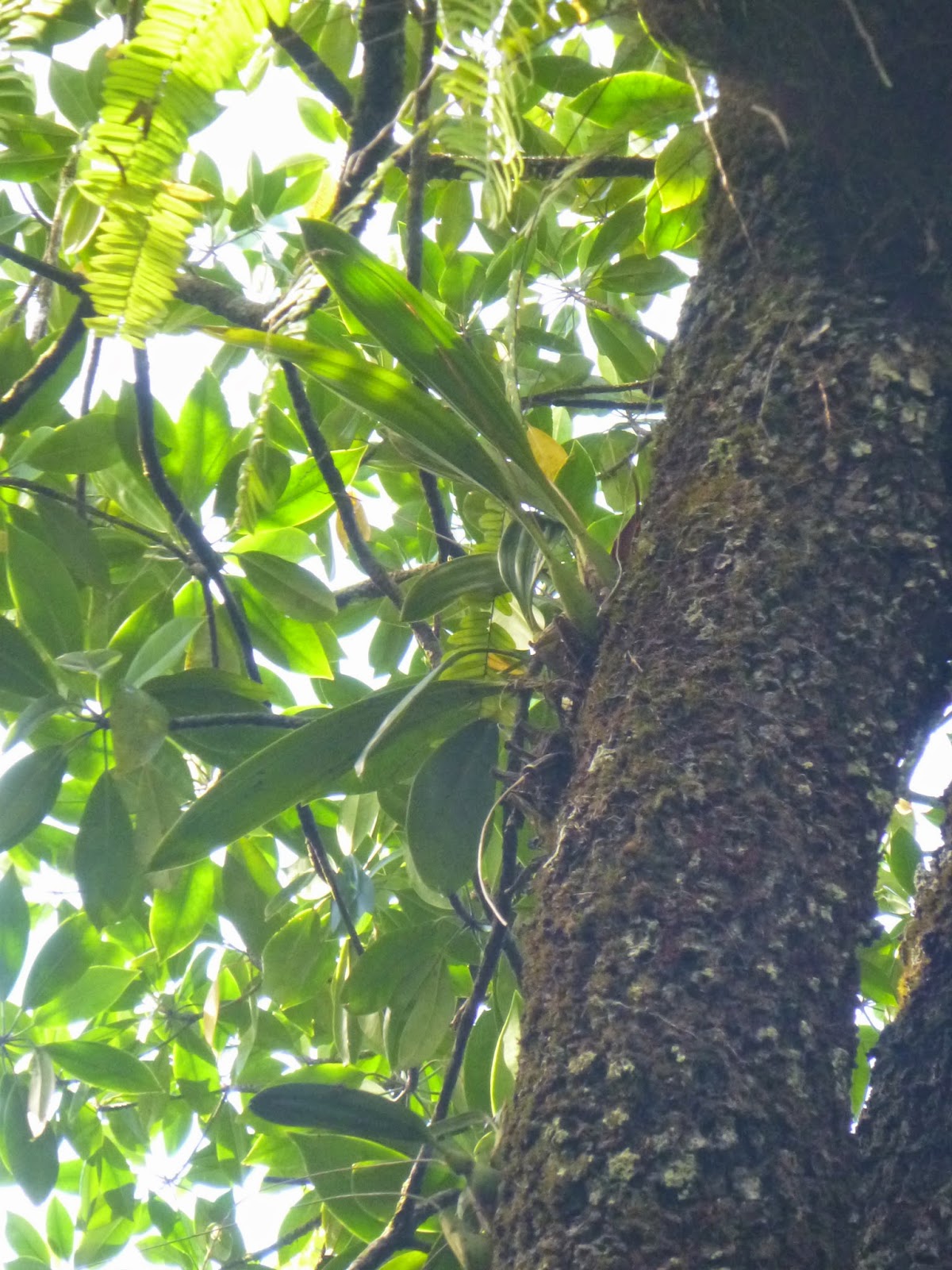 |
| A Dendrobium that I can't remember the name of |
That pretty much concludes that day in the Daintree. The night was taken up with our debate assignment and copious drinking and singing of Khe Sahn. Best field trip ever.


